In the physical trading of soft commodities, concluding a contract is only the beginning. Between purchasing a shipment of grain, sugar, coffee or oilseeds and its actual delivery and financial settlement, there are numerous interdependent processes. Throughout this entire chain, there are many variables. Every change – in volume, quality, timing, transportation and ultimately price – naturally affects the profitability and risk profile of the initial transaction. For commodity traders, the challenge is therefore not only to manage all these individual agreements effectively, but also to maintain a clear overview of the entire trading chain at any given moment.
We have already written extensively about position management, including “Why Accurate Position Management Is Critical for Commodity Traders in Volatile Markets” and a list of best practices. In this new article, we would like to share a practical calculation example.
More than just a contract
A physical commodity transaction rarely follows a simple, linear path from purchase to sale. However, we’re not here to explain the obvious and bring up the daily complexities of the trade. (We’ve done that already, in our recent publication on the evolution of CTRM software). We would however like to illustrate the point through a practical example.
Suppose a trader purchases a shipment of wheat that must be delivered to a customer several months later. The initial margin calculation may look attractive based on the purchase price, sales price and expected transportation costs. However, the economic outcome can change as the transaction progresses.
There are numerous reasons for this:
- Logistics: Higher freight rates, port congestion or demurrage charges can increase the total cost of the delivered cargo.
- Quality: Moisture content, protein content or other specifications may result in price adjustments or claims.
- Volume: The quantities actually loaded and delivered may differ from the volumes originally agreed in the contract.
- Timing: Delays can affect storage costs, financing and the timing of revenue recognition.
- Market exposure: Changes in futures prices or regional basis prices can affect hedge effectiveness.
Individually, these developments may appear manageable. Collectively, they can significantly change the final trading result.
The days when all this complexity could be captured in an Excel overview are long gone. (See also our article on spreadsheet mania). Physical trading requires more than contract management alone. It requires continuously updated insight into how commercial, operational and financial events affect the same transaction. The objective is not necessarily to bring every business process into a single application, but to establish a reliable connection between the processes and data that determine the economic outcome of each deal. Which brings us to our practical example.
Case Study: how a single shipment delay puts deal margins under pressure – and how your CTRM solution can help
In our interconnected, increasingly digitalized global market, the geopolitical climate, the rise of cybercrime, and overall economic uncertainty are just a few examples of factors that affect your bottom line – current international logistics being one of the most obvious ones.
Against this background – the real world – we present a hypothetical: an international grain trader purchases 25,000 tonnes of wheat from a supplier in the Black Sea region. The cargo is resold to a European buyer under an agreed delivery window and a planned sea freight route. When the transaction is concluded, the trader calculates an expected deal margin of €20 per tonne, or €500,000 for the entire shipment. The purchase price and sales price are contractually fixed. A hedge has also been established in the futures market to offset the relevant price risk. The original plan provides for timely loading and delivery. Logistics costs, the financing period and expected physical volumes have all been incorporated into the margin calculation.
At this point, the transaction appears financially attractive and manageable.
But then reality intervenes.
It starts with congestion at the port of departure. Available loading capacity is limited, and the vessel has to wait longer than planned. Ultimately, the shipment is delayed by 18 days.
Naturally, this delay does not remain confined to the logistics department. Like a river, it flows through other parts of the same transaction:
- The vessel incurs additional waiting time and demurrage costs
Depending on the charter agreement, additional demurrage charges may arise. Changes to the loading schedule may also result in additional port charges, rescheduling or higher transportation costs. At first glance, this may appear to be an operational issue. Financially, however, it directly reduces the transaction’s profitability. - Payment to the supplier has already been made, or is due under the original terms, while the sales proceeds arrive later
The delay extends the period between financing the purchase and receiving the sales proceeds. As a result, the trader’s capital remains tied up for longer in goods that are still in transit or cannot yet be delivered. Suppose that €4 million in working capital must be financed for an additional 18 days at an annual financing rate of 9%. The additional financing costs are approximately: €4,000,000 × 9% × 18 / 365 = approximately €17,753 – rounded off to €18.000. - The physical position remains open for longer or deviates from the originally planned delivery status
The hedge must be reassessed because the timing and size of the physical exposure may no longer correspond to the financial position. The trader has hedged the price exposure using futures contracts. However, a hedge does not guarantee that all risks associated with a physical transaction have been eliminated. For our example, €12,000 is allocated to the costs of adjusting the hedge. This amount is an illustrative cost item and is not an automatic consequence of an 18-day delay. - The expected deal margin decreases as costs rise and additional risks emerge
In other words, the core problem is that a single operational deviation generates multiple financial effects. Although these effects may appear relatively minor when considered separately, their combined impact can be material – and potentially substantial.
The calculation below illustrates how the delay affects the original margin.
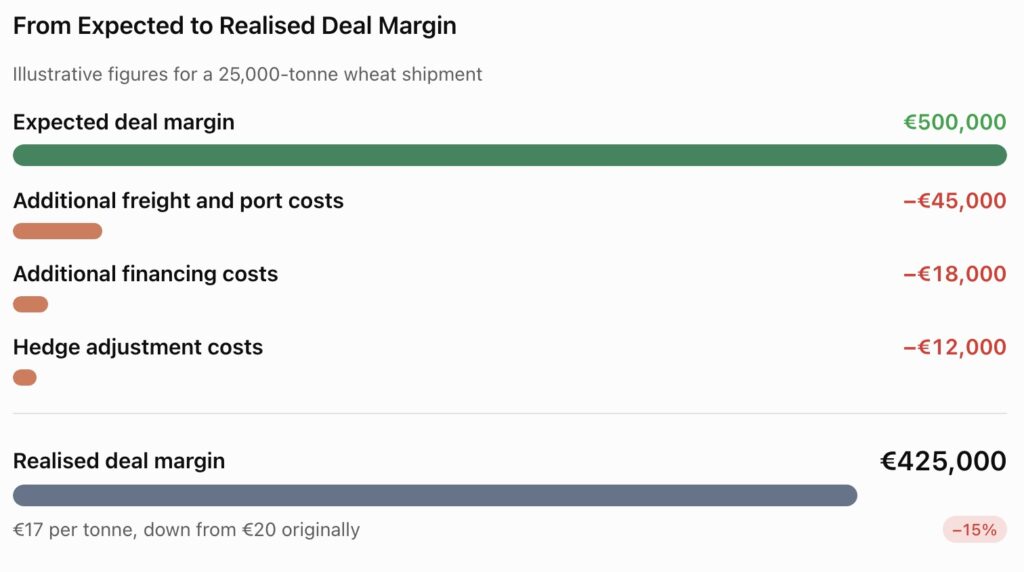
In short, the original margin of €20 per tonne falls to €17. The bottom-line impact is also 15% of the deal margin, amounting to approximately €75,000.
Naturally, the figures used here are illustrative. The scenario is hypothetical to begin with, and the actual impact depends on factors such as the charter terms, payment conditions, financing structure and the way the hedge has been established.
The transaction remains profitable, but a substantial portion of the original margin has disappeared because of a logistics event whose scale was not anticipated when the deal was concluded. In other situations, the impact may be greater – for example, if the delay results in contractual penalties, claims from buyers, additional storage costs or an unfavourable change in the physical basis price.
What could an integrated CTRM software solution have done?
A CTRM system cannot prevent port congestion or eliminate external market risks. However, it can help make the consequences visible earlier and enable different departments to work from the same transaction data.
1. Identify the impact on margins earlier
By linking the contractual margin to current freight costs, financing assumptions and expected additional expenses, the system can show how the expected deal margin changes as soon as a delay is recorded.
2. Gain insight into financial exposure
By monitoring physical volumes, expected delivery dates and hedge positions together, the trader can identify discrepancies between the physical position and the financial hedge. This supports a timely assessment of potential hedge adjustments.
3. Allocate costs to the correct transaction
When additional port charges, freight costs and financing expenses are linked to the appropriate contracts and transactions, a more reliable picture of actual profitability emerges. It also becomes easier to analyze the causes of margin deviations.
4. Compare scenarios before the situation escalates
With up-to-date data, traders can assess different scenarios. What happens to the margin if the delay extends by another seven days? What are the financial consequences of an alternative shipping route? And when does it become commercially attractive to take additional measures?
The quality of these insights depends on integration with logistics, financial and market data, the configuration of the calculations, and the speed at which new information becomes available. The value of a good CTRM solution therefore lies not only in recording contracts and positions. It lies in connecting commercial agreements, physical flows of goods, costs and financial risks.
The central question is not simply how much margin a deal promises at the outset, but also how quickly a company can recognize when that margin is coming under pressure.
Agiblocks was developed to meet both the technical and business needs of modern commodity trading organizations. As a multi-commodity CTRM solution built on modern technology, it supports the entire trading process – from contract drafting and pricing to logistics, risk management and position monitoring – helping traders work more efficiently with software designed for today’s business environment rather than yesterday’s.