
In the commodity trade, washout refers to a situation where two counterparties agree not to physically execute a contract to buy/sell a commodity, but instead settle the economic value of that contract financially. Which is why Agiblocks supports washout processing as a financial settlement as opposed to a physical movement of goods. That approach reflects these transactions more accurately in both operational workflows and financial accounting.
In this article, we explain how washout processing works in Agiblocks and how it provides a consistent representation across logistics, accounting, risk management and reporting.
WASHOUT, or wash-out, n.
DEFINITION (in commodity trade): the mutual cancellation of physical delivery obligations under a contract, settled financially instead of moving goods.
Executive summary: key benefits of washout processing in Agiblocks
· More accurate financial reporting
The accounting reflects the true economic outcome of the transaction without artificial inventory or logistics postings.
· Less reconciliation effort
Because no fictitious physical transactions are created, finance teams spend less time correcting or explaining discrepancies between operations and accounting.
· Greater operational clarity
Logistics, inventory and execution screens remain focused on transactions that actually require physical handling.
· Simpler invoicing
A single washout cost item represents the complete settlement, making receivables and payables straightforward to process.
· Better auditability
The original contract quantities remain visible for traceability, while the washed-out quantities are clearly marked as unavailable for further operational use.
Washout processing in general
In the commodity trade, washout refers to a situation where two counterparties agree not to physically execute a contract to buy/sell a commodity, but instead settle the economic value of that contract financially. Rather than delivering goods as per the usual outcome of a trade execution, both parties calculate the difference between the agreed contract price and the current or renegotiated price, and settle that difference in cash. The contract is fulfilled economically and not by any physical movement of commodities.
Because a washout is fundamentally a financial settlement, Agiblocks represents the transaction as such. The system records the financial settlement instead of recording any physical flows, in turn avoiding artificial logistics and inventory postings while aligning accounting, risk management and reporting with what has actually happened.
Washout processing in Agiblocks
A washout can be initiated directly from an open contract. Rather than requiring an existing opposite contract, you simply specify the agreed price difference and indicate whether the amount is payable to or receivable from the counterparty.
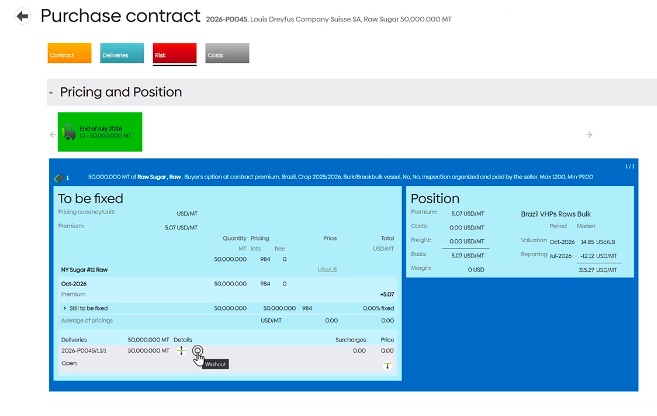
Based on this information, Agiblocks automatically generates the corresponding opposite contract. This contract mirrors the original in terms of goods, quantity and delivery conditions, while its pricing is derived from the original contract and adjusted by the agreed washout amount. This workflow closely reflects how washouts are agreed in practice and reduces the need for manual contract creation.
Quantity of zero
A key element of the Agiblocks design is the execution of the washout through a delivery with a quantity of zero. This ensures that no physical movement of goods is recorded in the system. Since the delivery quantity is zero, all quantity-dependent cost items – on both the purchase and sales side – are reduced to zero.
Consequently, no inventory or physical turnover is recorded in the accounting system.
Instead, the system generates a single washout cost item, calculated as a lump sum based on the agreed price difference and the contract quantity. This cost item represents the complete financial settlement and is assigned to either the purchase or sales side, depending on whether the amount is payable or receivable.
From an accounting perspective, Agiblocks will post only the washout costs, and no accruals for receipt or delivery of goods, to solely reflect the financial settlement. In other words, the financial impact is limited to the washout cost item, which can be invoiced either as receivable or payable. During invoicing, this washout cost item is the only amount to be settled. This simplifies the financial process and avoids the inclusion of transactions that have no physical counterpart. Following execution, the washed-out portion of the contract receives a Washout status rather than Delivered. This status is consistently reflected throughout the system, including logistics views, risk screens and mark-to-market reporting.
The quantities involved in the washout are retained for reference but marked as unused. This prevents further operational use while maintaining full traceability.
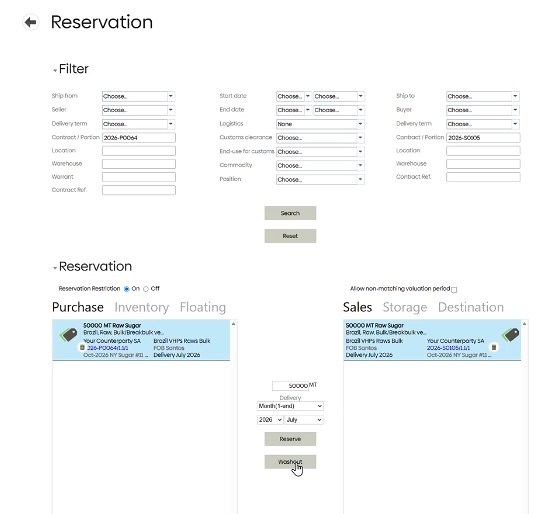
Agiblocks also supports scenarios where traders already created an opposite contract themselves and wish to link back-to-back contracts before initiating a washout via the reservation functionality. In these situations, the same processing logic applies, including the zero-quantity delivery and the generation of a single washout cost item.
Conclusion
Agiblocks provides a washout process that reflects the economic reality of a financial settlement without introducing artificial physical transactions. By separating financial settlement from physical execution, the system maintains consistency between operational processes, accounting records, risk management and reporting.
The result is clearer financial reporting, more accurate operational data and a workflow that closely matches the way washouts are handled in practice.
Ready to transform how you manage your operational and financial accounting? Let’s talk about how modern CTRM solutions can streamline your daily workflow.